
I woke up this Sunday morning thinking about church, and about singing in choir, when a stray thought snapped across my brain linking various data points and observations into a coherent whole:
Choirs are more egalitarian and inclusive than praise teams/praise bands, even though the music may be less “populist.”
I have been a church musician of one level or another for the past 40 years, I have sung or played at churches of various sizes, from small country churches, to mid-sized city churches, mega-churches, and moderate suburban/urban churches. I have seen high to low liturgy, strict classical music to pop-rock praise/worship music. I have been at churches when they made the transition from hymns and choir to praise teams/praise bands.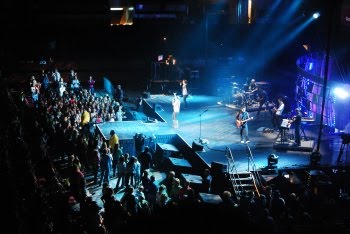
My observation is that when a church moves to a praise band they decrease the involvement of the congregation in the music ministry. Praise teams and praise bands are smaller things than choirs, needing fewer voices.
Some people view choirs as a select group. Actually they are one of the more diverse portions of the church. They cross age groups, genders, ethnicity. People of beginning and advanced talents work and sing side-by-side. They are a place of both spiritual and musical discipleship. Where a choir is a true ensemble it is a microcosm of the body, where each part is important and none deserving of more honor than the other.
Churches with choirs often have a “special music” slot in the service. This slot is seen by some as a performance slot for people to show off. What it really offers is an opportunity for individuals to use their musical gifts, whether they are the “top musicians” or not. It is a place for the established musician to practice humility in service, and to encourage the beginning musician to realize the value of nurturing their gift. It is another way that more people become involved in the music of the church.
When churches go to a praise band, this opportunity is frequently eliminated, and when not eliminated, is almost the exclusive property of the praise band. Special music is not generally limited to the choir in choral congregations.
One of the reasons churches choose a praise music format is to find something that appeals to more people, to draw them in, and make them participate in service. But with a band in front leading the music, the format mirrors that of the concerts people go to, with the same sense of participation and commitment. Sure, you sing along, but does it matter if you don’t?
In a choir-based congregational format, the members are truly part of the greater ensemble. Whether the voice is good on not, it is important that each member sings. Learning the joy of worshiping through the song is a duty and privilege of each member.
I have seen both forms of worship transitioning to the use of the projected words for the songs being sung. I have no problems with projected words as such, but they can encourage, especially in the praise band environment, a sort of musical illiteracy, along with a certain sense of exclusivity. The use of the hymn book, with music and words, encourages everyone to learn something about reading music, to nurture what talent they have. Just like regular reading, musical literacy is something you take with you everywhere. Even if you don’t know the song, you can still sing along wherever you are.
But if there are just words on the screen, and you don’t know the song, you are an outsider, struggling to learn your way in. You have created a sense of exclusion through your inclusive music. Reading music is a universal inclusion program. Words without written music is exclusive.
(As an aside, in an odd example of praise band exclusivity, I once was told I had “too good” a voice, so the church music director was unable to use me at one church that was going through a choir to praise band transition.)
Now let me address the question of praise music being closer to popular music. Popular music follows the performer/audience format. As mentioned previously, it comes from an environment and ethos that discourages the development of individual musical talent. It also focuses on unison and solo-type singing.
Hymn singing comes from the same tradition as choral singing in school, which is fortunately still taught in the schools I am acquainted with. It encourages group, part, ensemble singing. The principles of the music are more akin to the discipleship and body of Christ metaphors.
It is fine for church music to share similarities with the music of the day. But it is even better for it to have something different from it. Our object, our purpose for singing is different, and the music should reflect that. We should come together, to be nurtured, to learn, to grow, why not in our music as in the Word?
 At The Rainbow
Reblogged this on This, that, and the other thing.
LikeLike