
This year I am bumping my amateur athlete status up a notch.
Yesterday I played a four-game series in the intramural kickball championship at work.
Today I ran the Kansas City Corporate Challenge 5K
Later this month I might be doing the KCCC Bike Race (if I win the company tryouts for the 2 slots — 4 of us competing).
At the end of June I coordinate and swim in the KCCC Swim Meet.
On Father’s Day I do the KCCC Individual Triathlon.
So I am doing all three parts of the triathlon individually, and then for the Tri as well.
So let me talk about today’s 5K.

It was the second 5K I have run. The first one was last year, at the KCCC.
The race is tracked through computerized chips your wear on your shoe. When you cross the start line it logs your start time, and the same when you cross the finish line.
The start of the race is done in four waves, each one starting three minutes apart. The first wave is anyone who thinks they can run the race in under 24 minutes. The second wave is 25-28 minutes. The third wave is 29-36 minutes. The final wave is 37 minutes and above (but less than 75 minutes — you take more than 75 and your finish doesn’t count).
Last year I went to the front of the final wave, and finally got talked into the back of the third wave by the time the race started. I finished with a time of 28:57.6 (116 out of 163 in my age bracket).
This year I was trying to decide whether to go to the back of the second wave or front of the first wave. I opted for the back of the second wave. But by the time everyone packed in, I was fairly close to the center of the wave. I figured this should be the right pack for me — hoping I could do a bit better this year.
Last year when I crossed the finish line I saw the time on the clock, but didn’t know what time I had run — since the clock wasn’t on zero when I started. This year I watched the clock as I went across the start line. They didn’t start the second wave until the clock said 3 minutes, so when my center of the wave crossed the starting line the clock read 3:23. I waited and walked to just before the starting line and then started jogging.
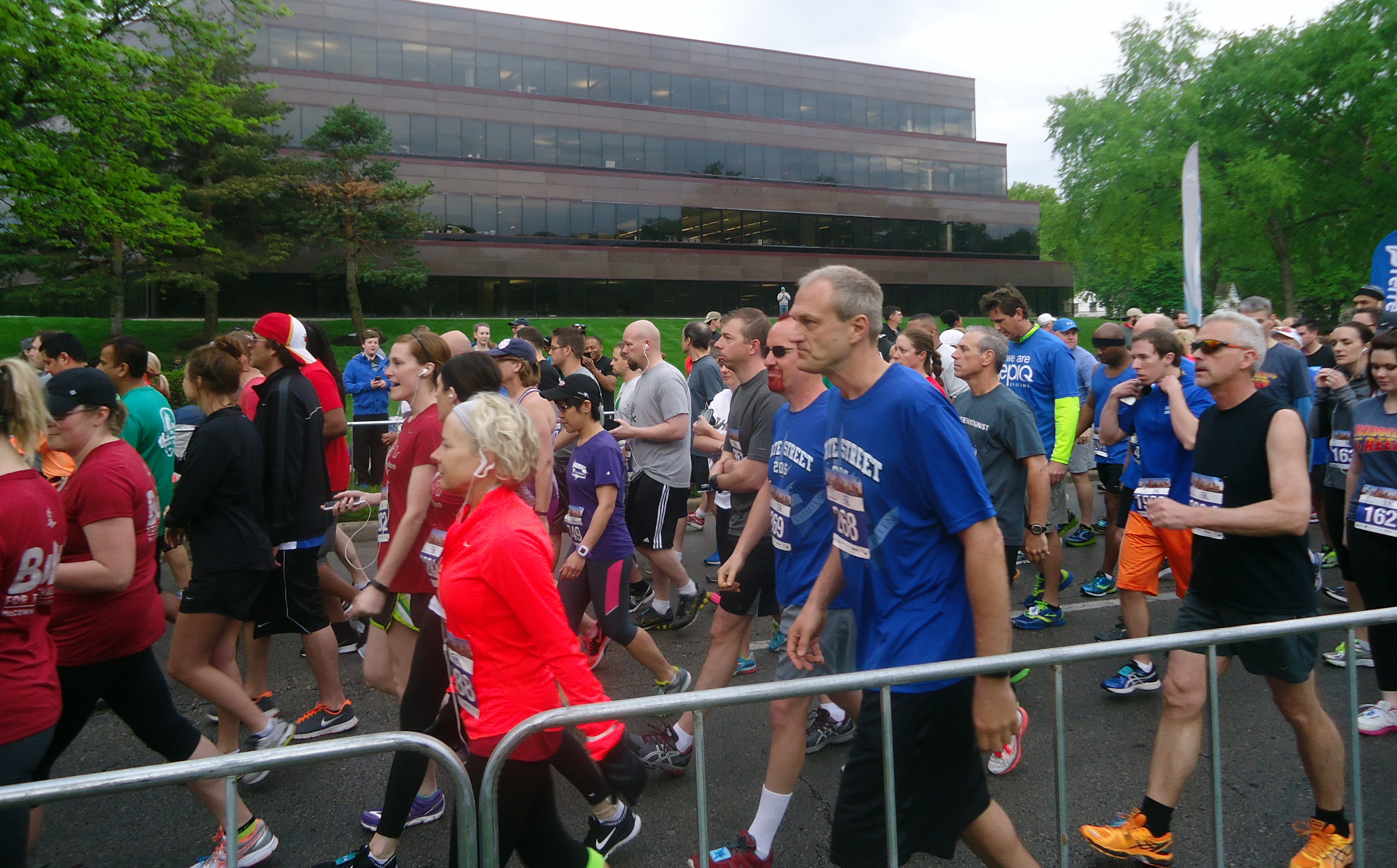
The course starts down Ward Parkway for about a block, and then turns and goes north, which also happens to be slightly uphill, until it reaches 83rd street, where it turns around and heads back to the finish line. There is a lot of jostling and position seeking on that first part into the turnaround and then the first block north. But after that point, the jostling isn’t no intense.

The hard part in a pack is how to find a pace and to keep it. You tend to pass people, or get passed by people, and sometimes you get a little walled up if you aren’t watching far enough ahead, and have to pull back until you can get around. All that pacing, the physiology and psychology of it, can have a significant effect on your time.
Last year I had a lot more space. Since I was faster than most of my pack I kept on passing forward. This year I was in the middle of my pack, and stayed in the middle, passing some and being passed by others.
One of my pacing advantages is that I have a fairly good sense of my maintenance pace. I can find the pace that is at the top of the speed I can maintain without having a fall-off or a burnout. There were a few people I passed along the patch that had started out faster ahead of me, and then, at the 1, or 2, or even half-way to the third mile just pulled up and almost stopped. They had burned out.
This year I found a pace fairly early and think I maintained it throughout the entire race. There were a couple of times where I had to slow slightly before I could get a clear passing, but I think I didn’t let it affect the overall pace.
Last year I started slow and found myself trying to go faster all the time, and had to keep checking myself to make sure I wasn’t overspeeding. I wasn’t, but I hadn’t quite learned my pacing last year.
The last two blocks to 83rd street actually go downhill before you turn the corner and head back, around the corner was the water station. Last year I was running slow enough I could drink the water while running, this year every time I tried to swallow most of the water in the cup went out and around my mouth. I put as much water on my shirt and in my goatee. The water around the goatee was actually a minor distraction until I wiped it off. The shirt — that was somewhat wet from sweat so it didn’t make that much difference.
Since the last two blocks go down to 83rd, the first two blocks headed south go uphill. It can be a bit of a struggle to run up, while drinking water, after turning a corner. But once you make it to the top of the hill, it is “all downhill” from there.
Well, actually I doubt that. It is basically all downhill, but the downhill runs out and becomes level, or a very slight uphill, on the last block or two to the finish line.
My pacing was fine for the turn, and getting up the hill, and then came the psychology to not feel the race was “almost over” too quickly, but to keep the pace solid. It gets tricky when you hit the flat stretch. You just know the finish line should be in view, but you can’t see it. I was battling with that, trying to decide when and whether I should put on a last burn of speed to the finish line. Too soon and I might have that dropout that I saw others do; too late and I miss the benefit that brings my time down.
Because the downside of being able to do your maintenance pace so well, is that a good racer knows how to use up the reserves during the race, so you give it all you have by the end, and not before. But when I start to increase my pace past maintenance I feel the reserve being used up, and my breath — it is always the breath that seems to be my limiter — gets tighter and faster. Learning to push through that, even to a sense of gasping, is the wall I face.
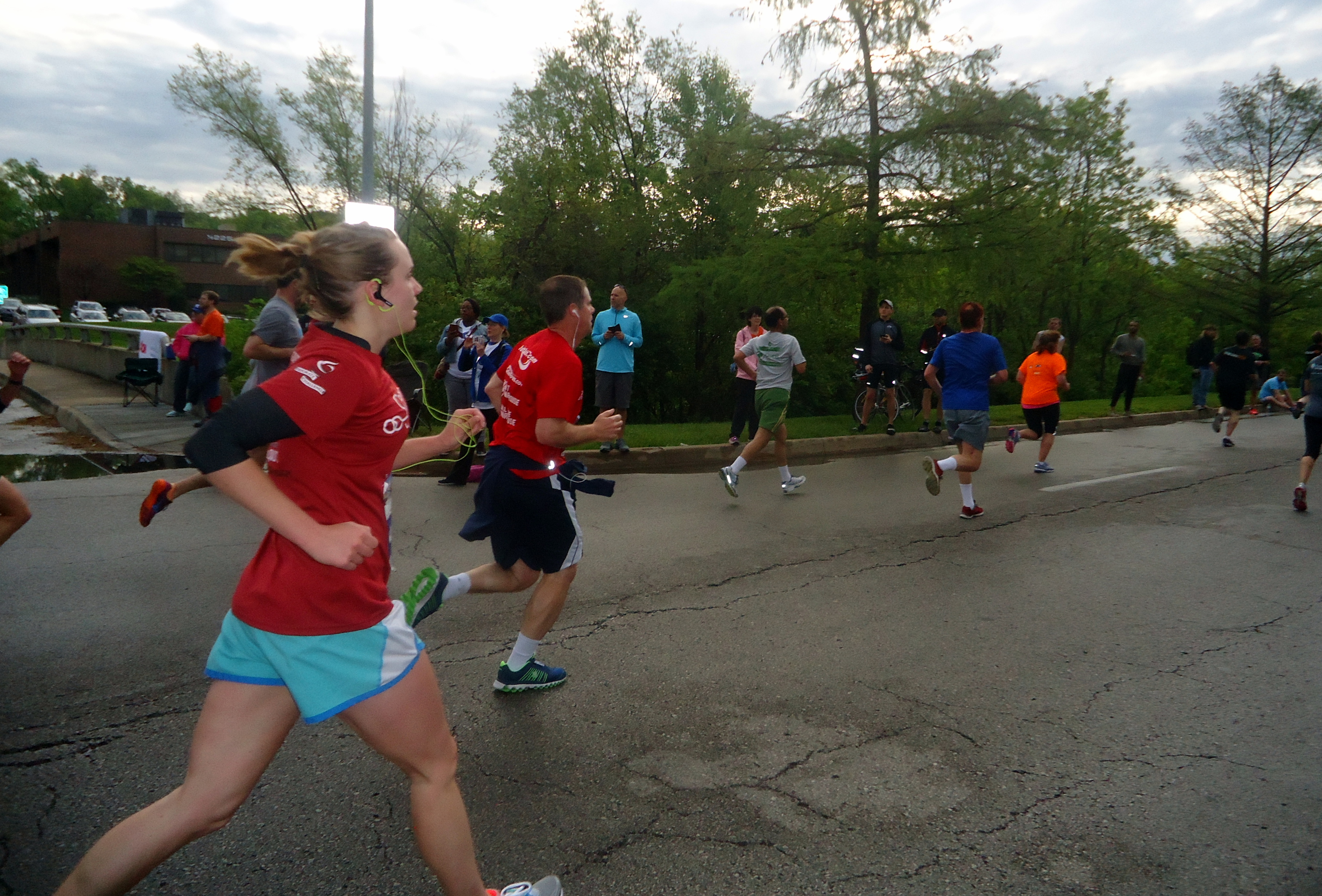
Today I started to push as soon as I could see the finish line, and started to get the sense of gasping. I pushed a little more — didn’t slow, but didn’t really accelerate a lot either. I did pass people the entire distance to the finish line — watching the time clock flash 29:19 as it left my vision while I was crossing the line.
I ran through the finish line. Major Kevin Hardin of the Army Reserves had told me the military aphorism — “move through the objective” — which means you don’t move to the target, you move through it. For the race it means keeping full speed until after you are past the finish line. So I crossed and then started to decelerate.
If I caught the clock time correctly, my time for the race should be under 26 minutes. But the official times won’t be up on the website until tomorrow or Monday.
After the race there are several sponsors and vendors that set up water and refreshment booths for the runners. There were bananas, oranges, protein balls, protein fortified chocolate milk product, bagel pieces, etc., and of course water. Everyone mills around, eats, talks, stretches, out, before heading off to the rest of their day.
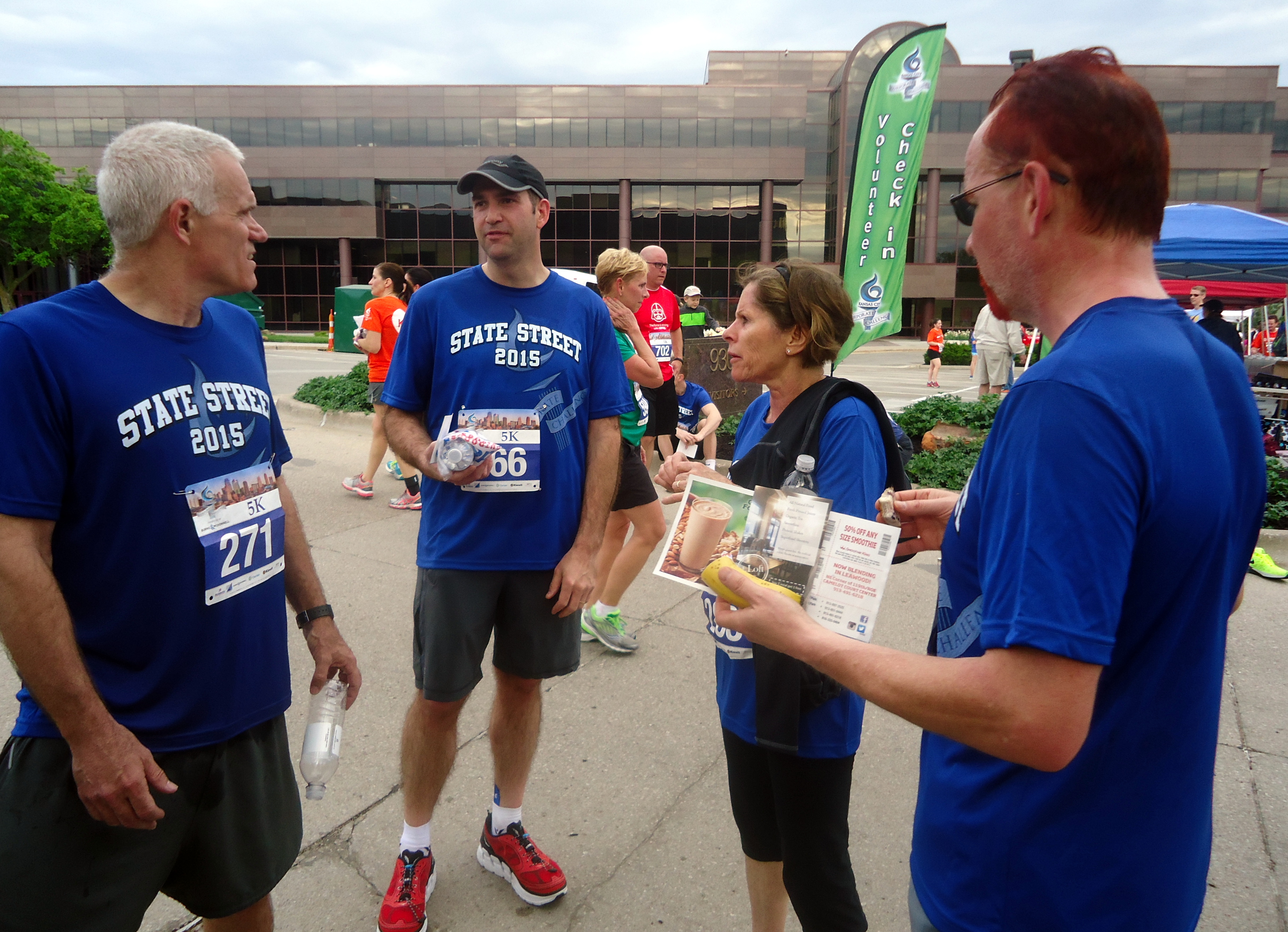
I guess I didn’t mention that the race started at 7:30 a.m., which means it was only 8 a.m. when I finished. Runners are often morning people, I guess.
 At The Rainbow