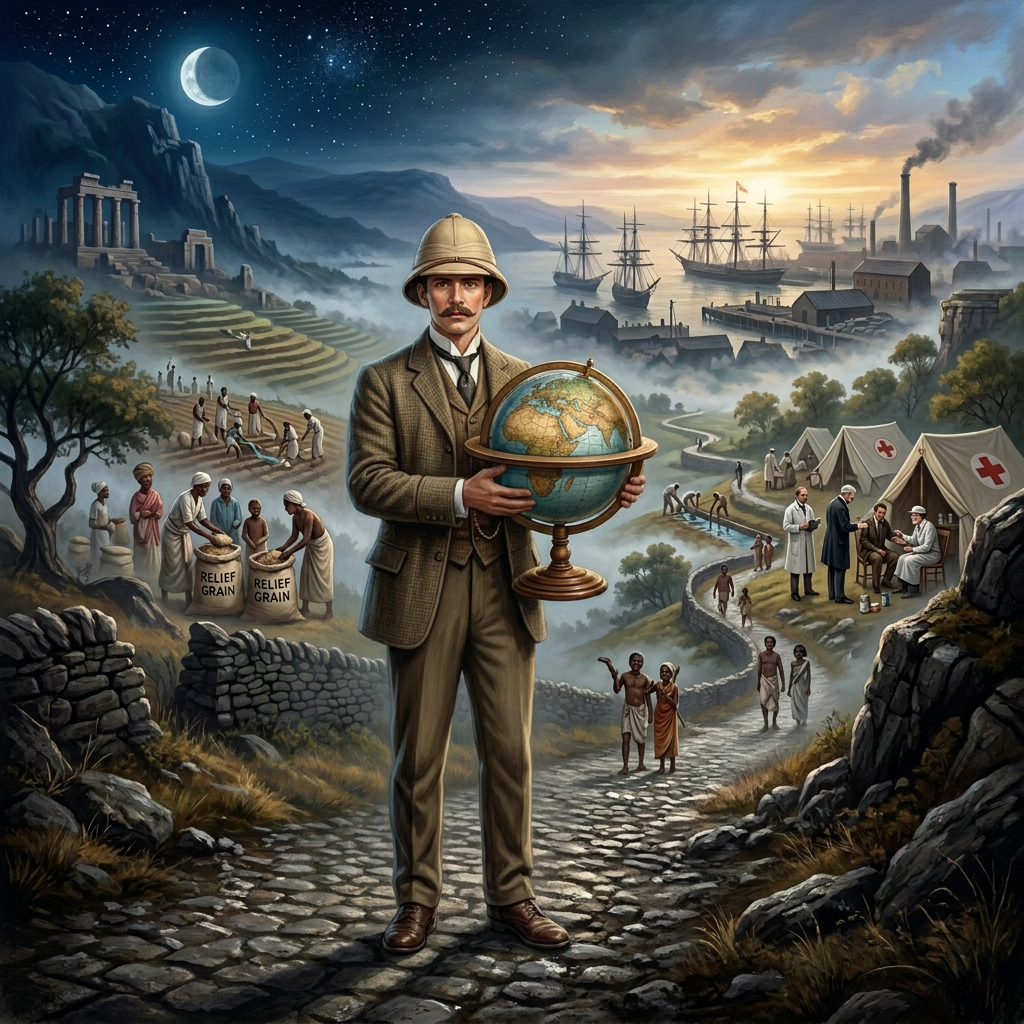

Today’s post includes a musical rendition of Rudyard Kipling’s poem “The White Man’s Burden” created in context of the Amelia Phenomenon. I will post the lyrics below the video box, and then add my commentary. The closed captions when i watched the video had multiple errors, so follow the lyrics i posted for best understanding.
Take up the White Man’s burden—
Send forth the best ye breed—
Go bind your sons to exile
To serve your captives’ need;
To wait in heavy harness
On fluttered folk and wild—
Your new-caught sullen peoples,
Half devil and half child.Take up the White Man’s burden—
In patience to abide
To veil the threat of terror
And check the show of pride;
By open speech and simple,
An hundred times made plain,
To seek another’s profit,
And work another’s gain.Take up the White Man’s burden—
The savage wars of peace—
Fill full the mouth of famine
And bid the sickness cease;
And when your goal is nearest
The end for others sought,
Watch sloth and heathen folly
Bring all your hopes to nought.Take up the White Man’s burden—
No tawdry rule of kings,
But toil of serf and sweeper—
The tale of common things.
The ports ye shall not enter,
The roads ye shall not tread,
Go make them with your living,
And mark them with your dead!Take up the White Man’s burden—
And reap his old reward:
The blame of those ye better,
The hate of those ye guard—
The cry of hosts ye humour
(Ah, slowly!) toward the light:
“Why brought ye us from bondage,
Our loved Egyptian night?”Take up the White Man’s burden—
Ye dare not stoop to less—
Nor call too loud on freedom
To cloak your weariness;
By all ye cry or whisper,
By all ye leave or do,
The silent, sullen peoples
Shall weigh your gods and you.Take up the White Man’s burden—
Have done with childish days—
The lightly proffered laurel,
The easy, ungrudged praise.
Comes now to search your manhood
Through all the thankless years,
Cold-edged with dear-bought wisdom,
The judgment of your peers!
The first thing I feel a need to emphasize, is that, though our modern age can see highly racialist underpinnings of the poem and its message, is that the poem is best understood through a cultural and religious viewpoint, and not a racial one. The cultural dynamic is the real driving force, though it be seen through an overlaid racial lense.
It is called the White Man’s Burden, not because white men are better, but because they were the current standard-bearers for the cultural and religious views standard that the poem is talking about. This is why there is a large contingent of non-white British Citizens in the United Kingdom today that are carrying the banner of their Unite the Kingdom movement, and its emphasis on the Christian heritage and culture that Britain represents to them.
These standards are what led the British Empire to spearhead the campaign to end slavery and the slave trade, a trade made possible to Europe and the West by the Islamic Caliphates that Europe had faced for centuries, and had consumed over a million white Europeans. In contrast, the Islamic Caliphates stripped Africa of around 18 million people and provided the foundation for the Western slave trade that stripped an additional 10 million, with maybe half a million of them landing in the United States. The vast bulk of them went to Spain and Portugal’s colonies in Central and South America.
The White Man, who had learned the slave trade from the Islamic Caliphates, realized its incompatibility with its creed and so was also the one to reject it and then end it.
Other elements of the White Man’s Burden was the drive for freedom — for both men and women, to cure and stop disease, and to see to each one’s need for food and shelter. We see this in the lines of the poem about “fill full the mouth of famine, and see the sickness cease”.
The poem notes that to do good for others is thankless — they will not appreciate it — and a burden.
There is the contrast of freeing these people from sickness and famine by taking them captive, and then teaching them how to be free. To free them by one thing by making them captives to you, and then teaching them how to be free of not only the sickness and famine, but ultimately of you.
You can see that the British Empire had the seeds of its own dissolution in its own creed. It could not make the world captive forever, and stay true to itself. It had to fight both the timeline leading to the freedom it sought to teach, and the ever-present resistance of its capitves’ to return to their “bondage, our loved Egyptian night.”
They were to go forth as servants to their captives, “To seek another’s profit, and work another’s gain.” Britain’s policies understood this better than France and Belgium, who reveled in the “tawdry rule of kings.”
But there was a definite sense of superiority in what they brought. And who can say they were wrong in that. One needs to compare it to what they replaced, indeed what has replaced them in many parts of the world, where the previous regimes have returned to once again bring famine and disease, and the enslavement of women.
Where has the White Man’s Burden failed? In its weariness, a call for freedom for themselves that has allowed the slavery of the world to reassert itself, yea even invade the lands of Christiandom, and undo the freedom of Christ. “It is for freedom that Christ has set us free. Stand firm then and do not let yourselves be burdened again by a yoke of slavery.”
We need to stand firm against the yoke of slavery being offered to us, a yoke that encourages us to forsake the burdens of liberty, the burden of bringing the captives out of their “loved Egyptian night”.
The one thing the title “White Man’s Burden” does is mislocate the source of the good they bring. It is something like “The Rights of Englishmen” that inspired much of the American Revolution. The Forefathers of the United States of America laid claim to their rights as Englishmen, but had an innate understanding that claiming them meant nothing special about them an Englishmen. To lay claim to those rights ultimately means to extend those rights to all men. They cannot be possessed as an inheritance only of those whose bloodline is English.
The White Man’s Burden may be better understood as the freedom in Christ that makes all Christians the servants of each other, but done at a political level instead of at the personal level. Christ’s message should definitely influence politics, but cannot ultimately be achieved by it. Which is perhaps why it has, or is, failing at the level of empires and politics.
Was it then an error to attempt it through empire? I believe it was not an error to use the might of empires to help accomplish it, but to believe that the might of empires itself would accomplish it, yes, that was an error.
And so, what lesson have we learned from this? I have made some suggestions, but would gladly receive input from others on where they think we should go from here… hopefully not back into our own “loved Egyptian night” which is where many are trying to lead us.

